In a world where road traffic noise is near-omnipresent, it might seem hard to believe that anyone could find pleasure in the sound of cars. In fact, motorsport enthusiasts would be delighted to explain the nuances of why a Porsche flat-six engine is without question the greatest sounding engine of all time, for example…

Despite harbouring highly subjective opinions on automotive sonic perfection, car fans will admit that racing events can be loud. Signs like the one below are plastered across UK motorsport venues, yet noise exposure is not always at the forefront of spectators’ minds.
As a conscientious acoustician and musician, I take my hearing seriously. My earplugs are always close at hand, and I’ll use them even in circumstances that wouldn’t raise the eyebrow of a librarian. Needless to say, dozens of unattenuated racing cars passing by at full speed would be unwelcome at a library.
The trip to Spa Francorchamps (in September 2025) began with a seamless drive from Gloucestershire to Folkestone and the Eurotunnel. The 3.5-hour backseat journey by Land Rover Freelander yielded an overall sound level of 74 dB LAeq,T with general conversation and no music – so far, so good. To preserve the battery of the dosemeter, no measurements were taken during the European leg of the journey, leaving opportunities for further research comparing British and French road noise. Similarly, typical sound levels in Belgian bars were undocumented on this occasion, with subjective impressions blurred by intoxication.
Friday morning saw us slightly worse for wear and arriving at the circuit by 10:30, with racing already underway. Once coffees had been obtained, we spent some time in the paddock area, where competitors were busy preparing their cars. I optimistically left my earplugs in my pocket but quickly changed my mind after observing levels of up to 110 dB(A) on the dosemeter. Our spectating began on the start/finish straight, with a combined race for pre 1965 and pre 1981 sports cars, though a long safety car period following a crash at La Source hairpin significantly lowered the noise exposure. To pass the time, we wandered through the Formula One pit area and found a Maserati 250F warming its engine. This led to the highest noise exposure of the entire weekend, with a whopping 143 dB LCpeak and sound pressure levels of over 116 dB(A) noted!
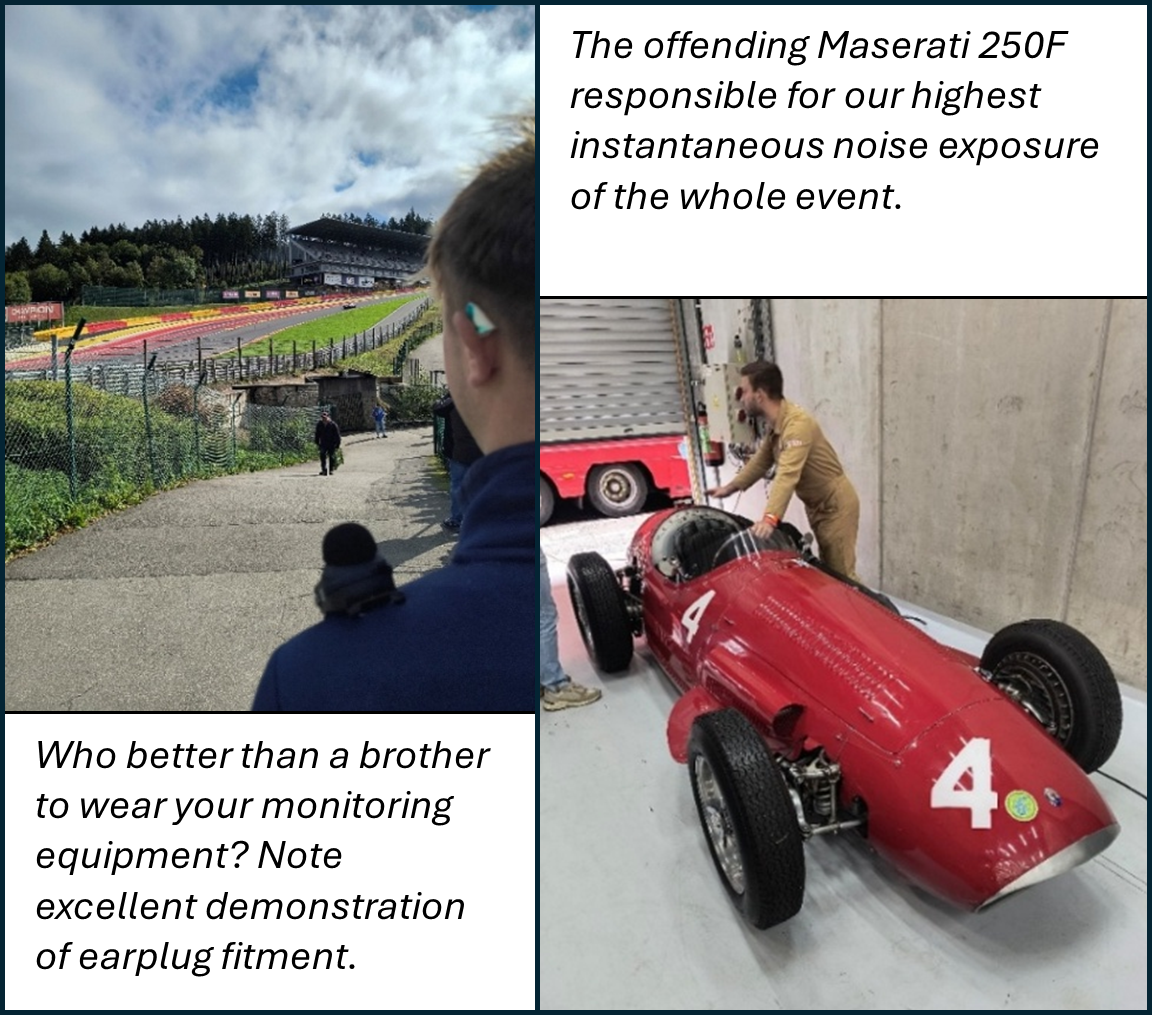
The afternoon was spent in the Raidillon grandstand, where a combination of tinny music and commentary through the PA system eliminated any chance of rest for the ears between races. The pre 1966 Grand Prix race was by far the loudest, with the pictured Maserati a clear winner for both best sounding and loudest car of the event.
The dosemeter only logs 1-minute LAeq data which masks the true drive-by sound level of the cars, but when the field was closely spaced, the dosemeter display registered sound pressure levels exceeding 110 dB(A). The overall measured sound level for this race was 95 dB LAeq,T, a full 10 dB higher than the following race.

Spectator histogram for Friday 26 September 2025 showing LAeq,1min and LCpeak values
Having enjoyed a full day of racing on Friday, we were content to spend more time infield on Saturday. The 6-hour race doesn’t commence until 4pm so we found ourselves in the paddock once again, where a Bugatti Type 35 warming its engine was no match for Friday’s Maserati. Even with our relaxed approach to spectating, we enjoyed a variety of races including Pre-War sports cars and an Alfa Romeo Cup which both yielded surprisingly modest noise exposure. Inevitably, we found ourselves in the bar, where rowdy voices, background music and distant racing yielded ambient sound levels of 80-85 dB(A). During this period, the chart for Saturday 27 September 2025 clearly shows a steady increase in ambient sound levels as spectators gathered for the big race.
Endurance racing pushes both car and driver to the limit and attracts only the hardiest spectators who are willing to sit outside until 10pm on a damp autumn evening. We passed the two hours until sunset on the pit mezzanine, experiencing drive by sound levels consistently above 120 dB LCpeak. A strategic leisurely dinner buffet halfway through the race had the potential to give our ears a break, though levels in the busy dining hall averaged 80 dB(A) which is too high for an effective rest area.
The night brings added intensity to the racing, with cars identifiable only by their headlights and exhaust note. To stave off the cold, we walked the length of the Kemmel Straight all the way to the semi-circular Bruxelles corner. Unsurprisingly, Kemmel gave our highest single minute of exposure of the day (103 dB LAeq,1min), where the fastest cars were comfortably exceeding 160mph as they passed by.

Spectator histogram for Saturday 27 September 2025 showing LAeq,1min and LCpeak values
In answer to the question ‘how loud is…historic motorsport’ an exhausting 12-hour day of motorsport resulted in an overall exposure of 87 dB LAeq,12hr. Our exposure on the day before was higher still, at 91 dB LAeq,8h.
To put this in context, guidance in the WHO “Environmental Noise Guidelines for the European Region” 2018 suggests that we should aim to reduce the yearly average from all leisure noise sources combined to 70 dB LAeq,24h. Converting the motorsport noise exposure over the weekend to a yearly average (assuming 365 days) equates to 62 dB LAeq,24h. Attending more than six weekends of historic motorsport in a year (without hearing protection) would cause this guideline level to be exceeded, based on the results of this investigation – and assuming no other elevated leisure activity noise exposure throughout the year.
In conclusion, regular attendees of historic motor racing events should remember to pack their hearing protection!
The 2018 World Health Organisation Environmental Noise Guidelines recommend a guideline exposure level of 70dB LAeq,24h yearly average from all leisure noise sources combined. The Guidelines give an example: an hourly noise level of 85 dB for 14 hours per week (e.g. 2 hours per day, 7 days a week) would lead to a yearly exposure of 74dB, exceeding the recommendations. WBM decided that it would be interesting to find out how loud leisure/hobby activities are and how readily the WHO guidelines might be exceeded by the “average” person…
We’re starting this series of investigations with a bang; by measuring how loud it was to attend the Women’s Rugby World Cup final matches at Twickenham on 27 September 2025! I wore a dosemeter throughout my attendance at Twickenham for both the bronze (New Zealand v France) and gold (Canada v England) matches. I was sitting in the west stand in the lower block, with a reasonable view of the pitch and rugby action.
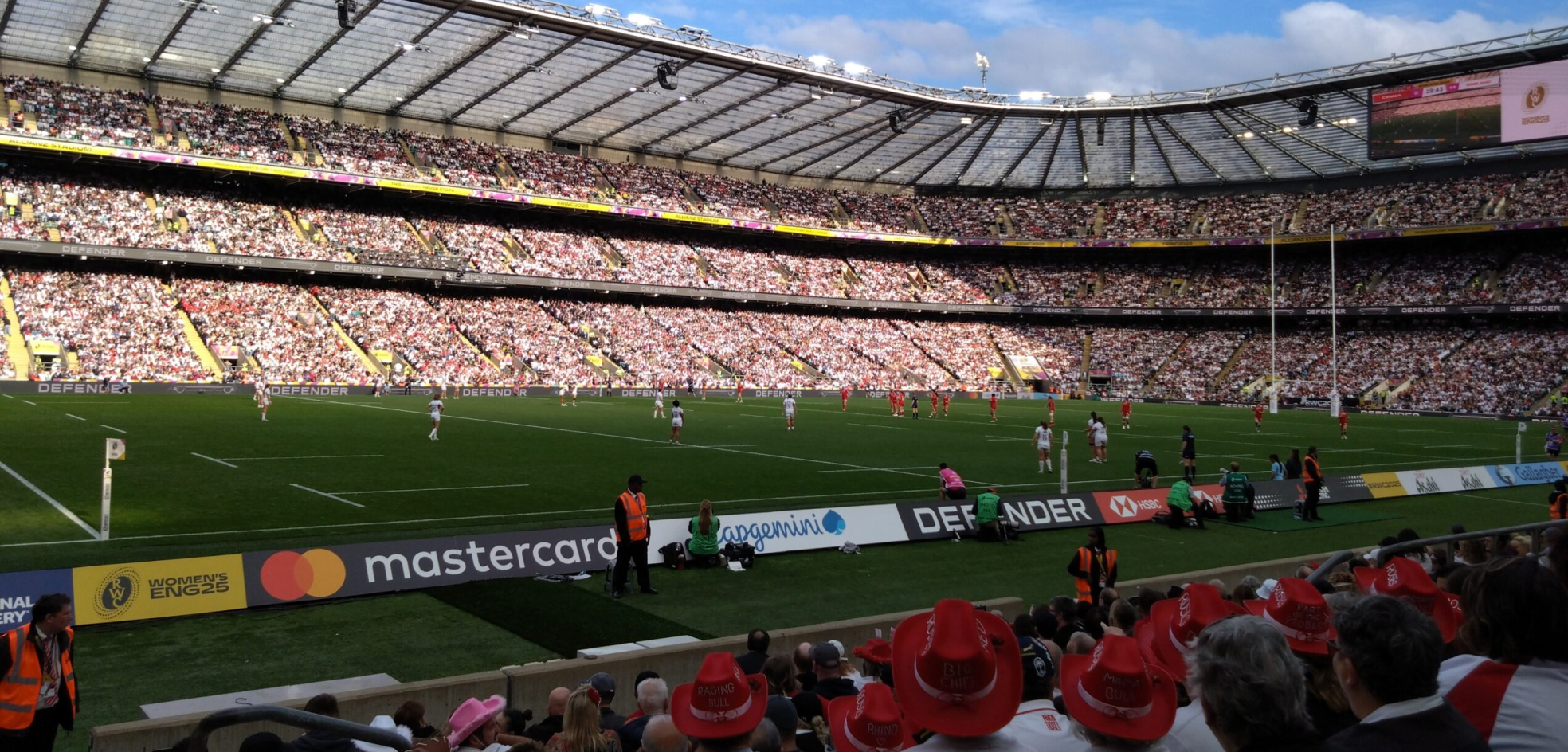
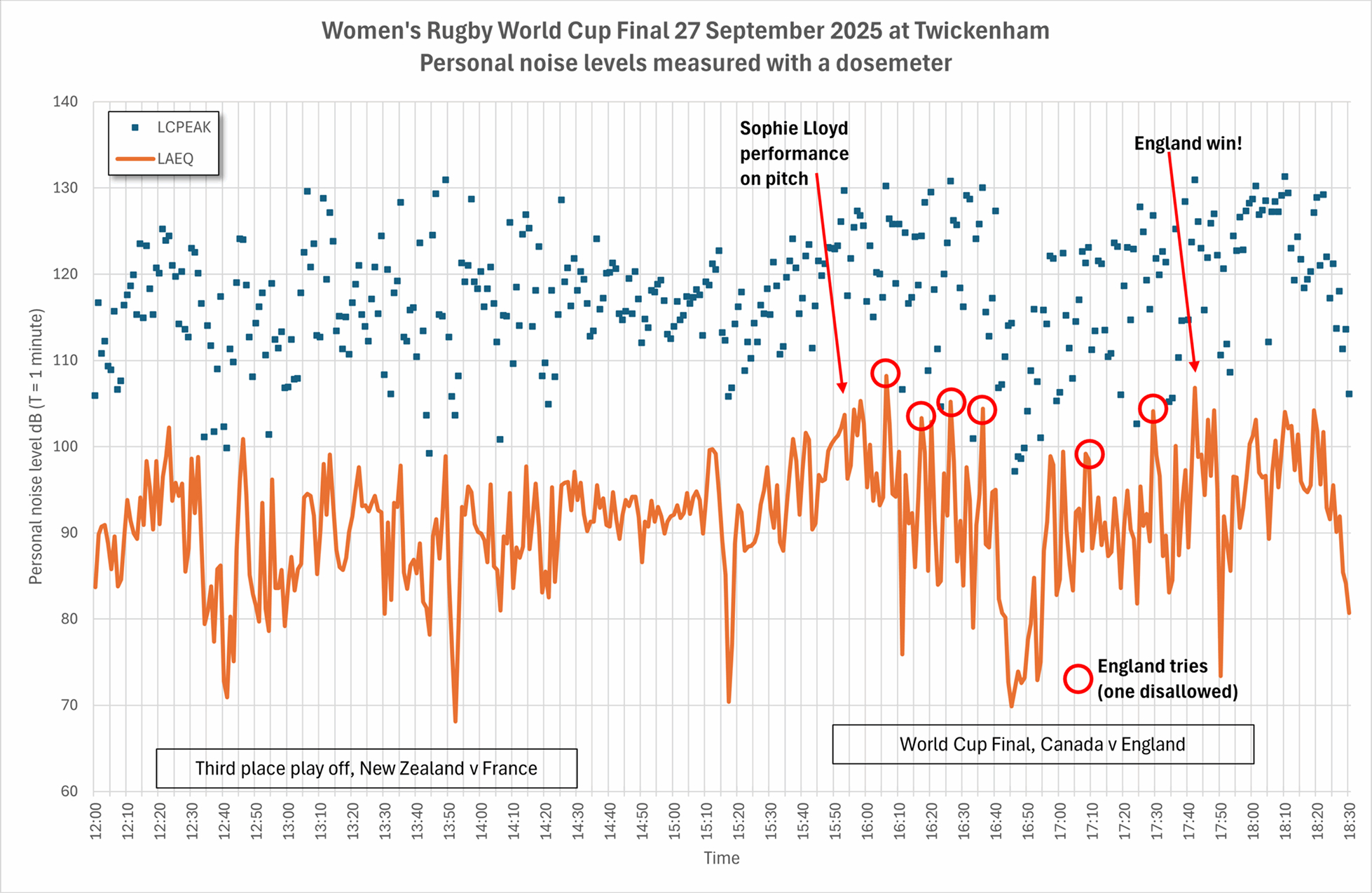
The noise levels were mainly due to the near 82k capacity crowd shouting and clapping, along with occasional music/announcements via the Twickenham PA – including a short live set on the pitch from Sophie Lloyd (guitarist) performing a medley of tracks. The second track was Bon Jovi’s ‘Livin’ On a Prayer’ and you’ve not lived until you’ve heard around 80,000 people singing ‘Oh, we’re half way there…’. This musical interlude did create the highest short term LAeq,T values – until England started scoring tries that is!
In answer to the question ‘how loud is…attending the Women’s Rugby World Cup bronze and gold matches at Twickenham’ the answer is an eye-watering 96 dB LAeq,T for the near 7 hours I was at the stadium, although subjectively it didn’t seem that loud – possibly as some of this would have been created by my own shouting (this generated over 90 dB LAeq,T – although I did not shout continuously over the entire duration).
Conclusions
1) Converting my noise exposure of 96 dB LAeq,T to a yearly average (assuming 365 days) equates to 65 dB LAeq,24h. This is only 5 dB below the recommended annual limit – so I will need to be mindful of further noisy leisure activities that I attend over the next 12 months!
Not all rugby matches will be as vigorously loud as the world cup final, and I wouldn’t usually be in a stadium for that amount of time. Using the average noise level for the time period from 12:00 to 14:30 that covered the New Zealand v France match (93 dB LAeq,T), this converts to a yearly average value of 57 dB LAeq,24h. Assuming this is more typical of the rugby union matches I attend (Northampton Saints or Loughborough Lightnings), this indicates that I could attend up to 20 matches per year at this magnitude before the recommended 70 dB LAeq,24h yearly average is exceeded. However this does not take into account exposure from other leisure activities.
Clearly more research is needed so I’ll need to wear the dosemeter at more rugby matches…
2) The Red Roses kick ass!

The draft version of BS 8233 was published in June 2025.
Part of the work that WBM undertakes for our clients is the reviewing of planning applications for residential developments near to industrial / mineral related sites – which often refer to BS 8233.
The draft standard contains major changes compared to the existing version of BS 8233. Some examples of the main changes with regard to dwellings are listed below:
- The guidance for new dwellings relates to external noise from transportation sources only
- There is no differentiation between different types of rooms
- The approach for dwellings is to categorise the external noise, depending on type of transportation noise and magnitude, and provide a composite sound insulation performance for façades based on the external noise category – although some internal level targets are provided
- External noise affecting dwellings is defined in terms of the Lden and Lnight
- Internal level targets in dwellings are in terms of Lden
- There are no longer any noise level targets for external amenity areas
- There is negligible guidance provided when dwellings are exposed to other types of non-transportation noise (such as commercial/industrial sources), with limited reference to BS 4142 or the ‘agent of change’ principle
WBM has numerous concerns about the draft standard and will be responding formally on the consultation.
Please get in touch if you need a weblink to access the draft standard.
The end date for public comments is 06 September 2025.