
WBM

Latest News

Noise NOT at work #2: How Loud Is…Historic Motorsport? A weekend at Spa Francorchamps by Johan Beavis-Berry

Noise NOT at work #2: How loud is…Historic Motorsport? A weekend at Spa Francorchamps by Johan Beavis-Berry (WBM)

In a world where road traffic noise is near-omnipresent, it might seem hard to believe that anyone could find pleasure in the sound of cars. In fact, motorsport enthusiasts would be delighted to explain the nuances of why a Porsche flat-six engine is without question the greatest sounding engine of all time, for example…

Despite harbouring highly subjective opinions on automotive sonic perfection, car fans will admit that racing events can be loud. Signs like the one below are plastered across UK motorsport venues, yet noise exposure is not always at the forefront of spectators’ minds.

As a conscientious acoustician and musician, I take my hearing seriously. My earplugs are always close at hand, and I’ll use them even in circumstances that wouldn’t raise the eyebrow of a librarian. Needless to say, dozens of unattenuated racing cars passing by at full speed would be unwelcome at a library.

The trip to Spa Francorchamps (in September 2025) began with a seamless drive from Gloucestershire to Folkestone and the Eurotunnel. The 3.5-hour backseat journey by Land Rover Freelander yielded an overall sound level of 74 dB LAeq,T with general conversation and no music – so far, so good. To preserve the battery of the dosemeter, no measurements were taken during the European leg of the journey, leaving opportunities for further research comparing British and French road noise. Similarly, typical sound levels in Belgian bars were undocumented on this occasion, with subjective impressions blurred by intoxication.

Friday morning saw us slightly worse for wear and arriving at the circuit by 10:30, with racing already underway. Once coffees had been obtained, we spent some time in the paddock area, where competitors were busy preparing their cars. I optimistically left my earplugs in my pocket but quickly changed my mind after observing levels of up to 110 dB(A) on the dosemeter. Our spectating began on the start/finish straight, with a combined race for pre 1965 and pre 1981 sports cars, though a long safety car period following a crash at La Source hairpin significantly lowered the noise exposure. To pass the time, we wandered through the Formula One pit area and found a Maserati 250F warming its engine. This led to the highest noise exposure of the entire weekend, with a whopping 143 dB LCpeak  and sound pressure levels of over 116 dB(A) noted!

The afternoon was spent in the Raidillon grandstand, where a combination of tinny music and commentary through the PA system eliminated any chance of rest for the ears between races. The pre 1966 Grand Prix race was by far the loudest, with the pictured Maserati a clear winner for both best sounding and loudest car of the event.

The dosemeter only logs 1-minute LAeq data which masks the true drive-by sound level of the cars, but when the field was closely spaced, the dosemeter display registered sound pressure levels exceeding 110 dB(A). The overall measured sound level for this race was 95 dB LAeq,T, a full 10 dB higher than the following race.
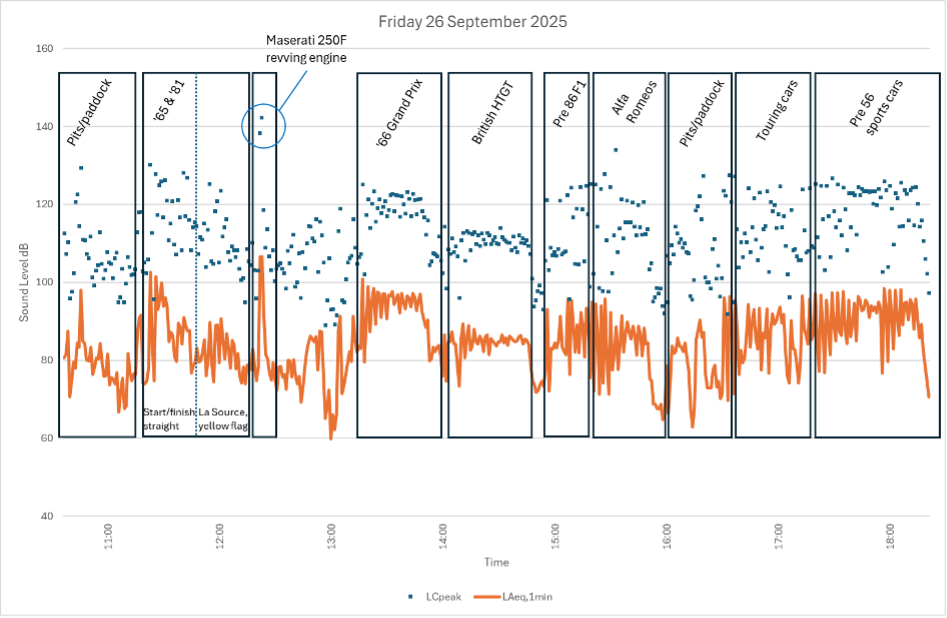
Spectator histogram for Friday 26 September 2025 showing LAeq,1min and LCpeak values

Having enjoyed a full day of racing on Friday, we were content to spend more time infield on Saturday. The 6-hour race doesn’t commence until 4pm so we found ourselves in the paddock once again, where a Bugatti Type 35 warming its engine was no match for Friday’s Maserati. Even with our relaxed approach to spectating, we enjoyed a variety of races including Pre-War sports cars and an Alfa Romeo Cup which both yielded surprisingly modest noise exposure. Inevitably, we found ourselves in the bar, where rowdy voices, background music and distant racing yielded ambient sound levels of 80-85 dB(A). During this period, the chart for Saturday 27 September 2025 (overleaf) clearly shows a steady increase in ambient sound levels as spectators gathered for the big race.

Endurance racing pushes both car and driver to the limit and attracts only the hardiest spectators who are willing to sit outside until 10pm on a damp autumn evening. We passed the two hours until sunset on the pit mezzanine, experiencing drive by sound levels consistently above 120 dB LCpeak. A strategic leisurely dinner buffet halfway through the race had the potential to give our ears a break, though levels in the busy dining hall averaged 80 dB(A) which is too high for an effective rest area.

The night brings added intensity to the racing, with cars identifiable only by their headlights and exhaust note. To stave off the cold, we walked the length of the Kemmel Straight all the way to the semi-circular Bruxelles corner. Unsurprisingly, Kemmel gave our highest single minute of exposure of the day (103 dB LAeq,1min), where the fastest cars were comfortably exceeding 160mph as they passed by.
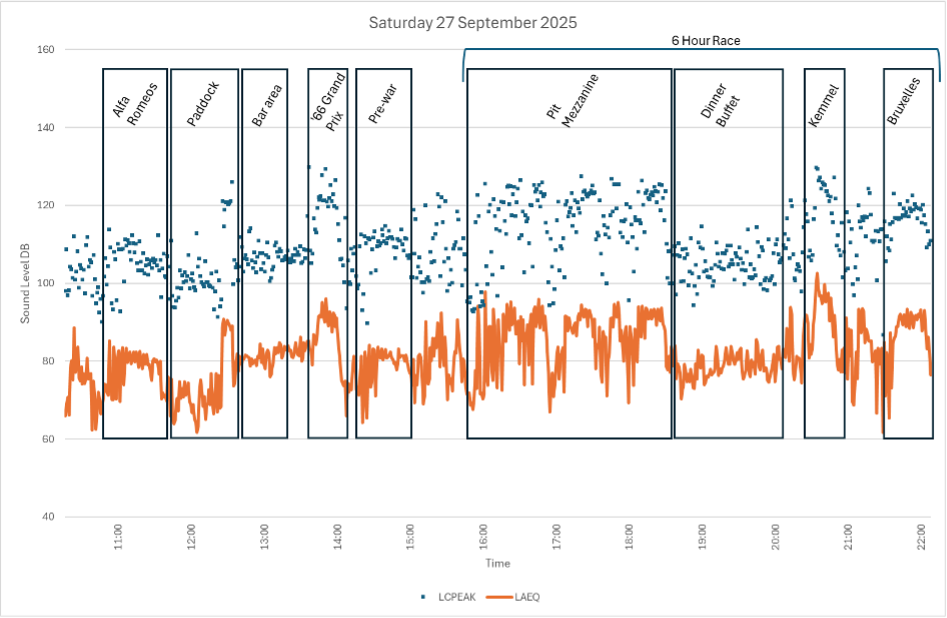
Spectator histogram for Saturday 27 September 2025 showing LAeq,1min and LCpeak values

In answer to the question ‘how loud is…historic motorsport’ an exhausting 12-hour day of motorsport resulted in an overall exposure of 87 dB LAeq,12hr. Our exposure on the day before was higher still, at 91 dB LAeq,8h.

To put this in context, guidance in the WHO “Environmental Noise Guidelines for the European Region” 2018 suggests that we should aim to reduce the yearly average from all leisure noise sources combined to 70 dB LAeq,24h. Converting the motorsport noise exposure over the weekend to a yearly average (assuming 365 days) equates to 62 dB LAeq,24h.  Attending more than six weekends of historic motorsport in a year (without hearing protection) would cause this guideline level to be exceeded, based on the results of this investigation – and assuming no other elevated leisure activity noise exposure throughout the year.

In conclusion, regular attendees of historic motor racing events should remember to pack their hearing protection!
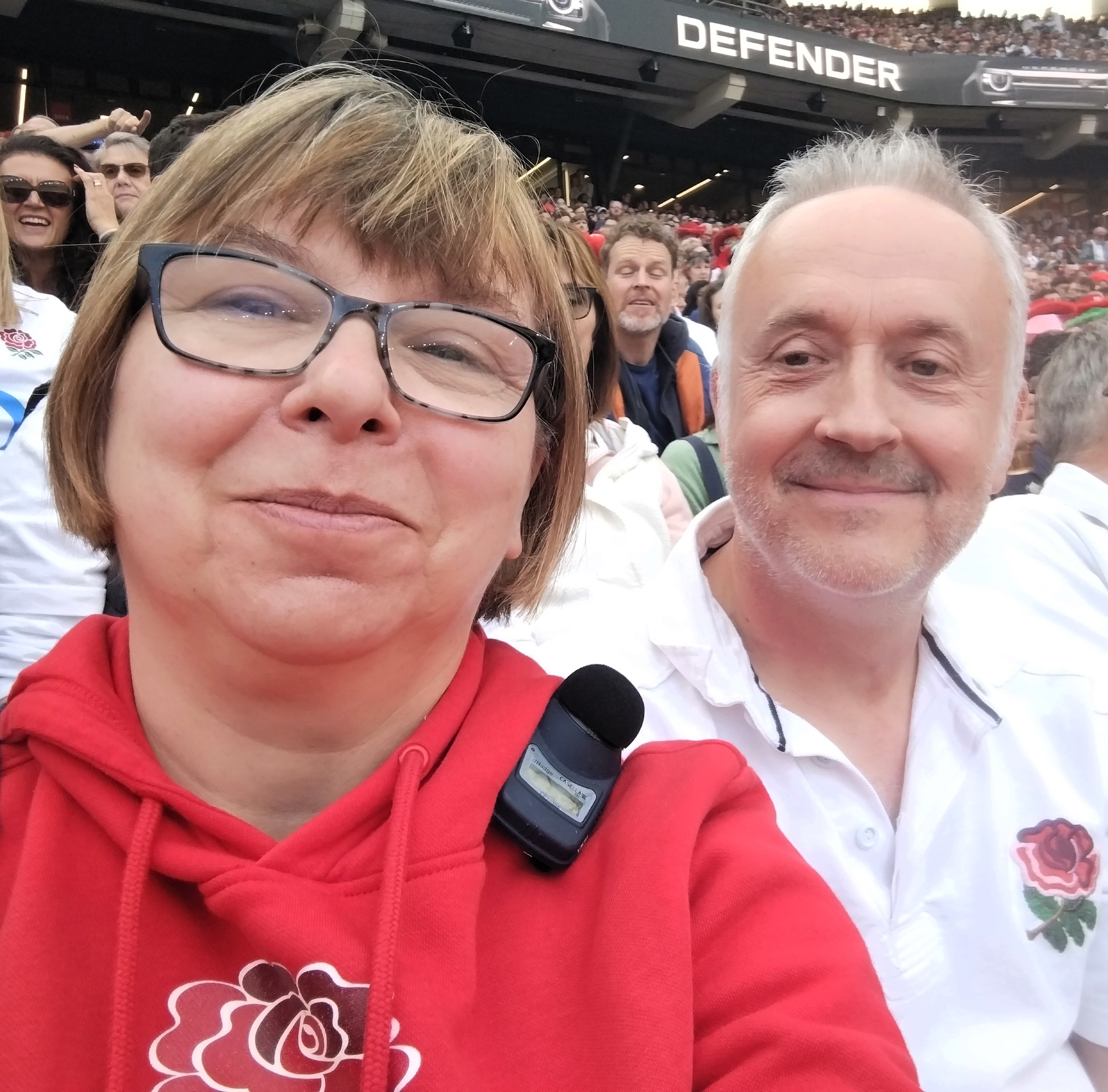
Noise NOT at Work #1 – Women’s Rugby World Cup at Twickenham, September 2025

Noise NOT at work #1: How loud is…attending the Women’s Rugby World Cup bronze and gold matches at Twickenham by Rachel Canham (WBM)

The 2018 World Health Organisation Environmental Noise Guidelines recommend a guideline exposure level of 70dB LAeq,24h yearly average from all leisure noise sources combined. The Guidelines give an example: an hourly noise level of 85 dB for 14 hours per week (e.g. 2 hours per day, 7 days a week) would lead to a yearly exposure of 74dB, exceeding the recommendations. WBM decided that it would be interesting to find out how loud leisure/hobby activities are and how readily the WHO guidelines might be exceeded by the “average” person…

We’re starting this series of investigations with a bang; by measuring how loud it was to attend the Women’s Rugby World Cup final matches at Twickenham on 27 September 2025! I wore a dosemeter throughout my attendance at Twickenham for both the bronze (New Zealand v France) and gold (Canada v England) matches. I was sitting in the west stand in the lower block, with a reasonable view of the pitch and rugby action.
The noise levels were mainly due to the near 82k capacity crowd shouting and clapping, along with occasional music/announcements via the Twickenham PA – including a short live set on the pitch from Sophie Lloyd (guitarist) performing a medley of tracks. The second track was Bon Jovi’s ‘Livin’ On a Prayer’ and you’ve not lived until you’ve heard around 80,000 people singing ‘Oh, we’re half way there…’. This musical interlude did create the highest short term LAeq,T values – until England started scoring tries that is!

In answer to the question ‘how loud is…attending the Women’s Rugby World Cup bronze and gold matches at Twickenham’ the answer is an eye-watering 96 dB LAeq,T for the near 7 hours I was at the stadium, although subjectively it didn’t seem that loud – possibly as some of this would have been created by my own shouting (this generated over 90 dB LAeq,T – although I did not shout continuously over the entire duration).

Conclusions

1) Converting my noise exposure of 96 dB LAeq,T to a yearly average (assuming 365 days) equates to 65 dB LAeq,24h. This is only 5 dB below the recommended annual limit – so I will need to be mindful of further noisy leisure activities that I attend over the next 12 months!

Not all rugby matches will be as vigorously loud as the world cup final, and I wouldn’t usually be in a stadium for that amount of time. Using the average noise level for the time period from 12:00 to 14:30 that covered the New Zealand v France match (93 dB LAeq,T), this converts to a yearly average value of 57 dB LAeq,24h. Assuming this is more typical of the rugby union matches I attend (Northampton Saints or Loughborough Lightnings), this indicates that I could attend up to 20 matches per year at this magnitude before the recommended 70 dB LAeq,24h yearly average is exceeded. However this does not take into account exposure from other leisure activities.

Clearly more research is needed so I’ll need to wear the dosemeter at more rugby matches…

2) The Red Roses kick ass!

Updated Draft to British Standard 8233 “Sound insulation and noise reduction for buildings – Guide”

The draft version of BS 8233 was published in June 2025. This standard is one of the most important documents relating to acoustics, and is often used by acoustic consultants and environmental health officers / planners respectively – particularly with regard to the setting of internal noise limits for new residential development.

Part of the work that WBM undertakes for our mineral clients is the reviewing of planning applications for residential developments near to industrial / mineral related sites – which often refer to BS 8233.

The draft standard contains major changes compared to the existing version of BS 8233. Some examples of the main changes with regard to dwellings are listed below:

  • The guidance for new dwellings relates to external noise from transportation sources only
  • There is no differentiation between different types of rooms
  • The approach for dwellings is to categorise the external noise, depending on type of transportation noise and magnitude, and provide a composite sound insulation performance for façades based on the external noise category – although some internal level targets are provided
  • External noise affecting dwellings is defined in terms of the Lden and Lnight
  • Internal level targets in dwellings are in terms of Lden
  • There are no longer any noise level targets for external amenity areas
  • There is negligible guidance provided when dwellings are exposed to other types of non-transportation noise (such as commercial/industrial sources), with limited reference to BS 4142 or the ‘agent of change’ principle

WBM has numerous concerns about the draft standard and will be responding formally on the consultation.

Please get in touch if you need a weblink to access the draft standard.

The end date for public comments is 06 September 2025.

Environment Agency ‘Method implementation document’ for BS 4142

Environment Agency ‘Method implementation document’ for BS 4142

The Environment Agency has published a ‘Method implementation document’ (MID) about BS 4142:2014+A1:2019 (BS 4142). This document sets out the Environment Agency’s requirements for BS 4142 assessments that are submitted for a new permit or varying an existing permit

The MID was published in March 2023 and updated in December 2023.

Part of the Environment Agency requirements are that the background sound must not include existing site sounds. During noise measurements, all site activities should be reduced where they no longer contribute to the background level and where they cannot be heard at the measurement location. The background sound level must not include any sound from the site.

This can be problematic for existing sites with current operations. The Environment Agency suggest that the site temporarily stops any noisy operations, or the use of a surrogate monitoring location (with justification).

In addition, the Environment Agency requires the BS 4142 assessment to consider all sound from a site, not just the new or increased portion.

WBM has undertaken many BS 4142 assessments for sites seeking new or varied permits, providing information to comply with the Environment Agencies requirements.

The links for the MID, and also for the noise and vibration requirements for environmental permits are provided on WBM’s website, see:
https://www.wbm.co.uk/documents/

Spring Wood Lodge, Leeds

Further to the recent post about St Sidwell’s Point, we’ve also added Spring Wood Lodge to our list of example projects

Spring Wood Lodge, in Guisley, Leeds, provides a rehabilitation recovery centre for women over the age of 18 requiring an integrated treatment approach. The facility has a nine bed and a twelve bed ward and had permission for a new extension to include six bedrooms along with ensuites, lounge, nurse station, clinic, sluice, office, de-escalation room, bathroom and other ancillary and circulation spaces…

Read More

St Sidwell’s Point, Exeter

WBM is pleased to include this project to our portfolio.
St Sidwell’s Point, Exeter

St Sidwell’s Point was commissioned by Exeter City Council and designed by S&P Architects integrated design team and is the UK’s first Passivhaus leisure centre. The £42M four-floor centre is located in Exeter city centre and accommodates three swimming pools, a 100 seat spectator area, three studios, a fitness gym, a large premium health and beauty spa (GAIA Spa), a crèche and a café, together with an external landscaped terrace on the upper floor overlooking the city…

Read More

WBM Changes 2021 to 2022

Following our 50 year milestone as a partnership in April 2020, we have this year made the switch to a limited company and, despite the fallout from the pandemic, we continue to deliver our usual first class service, putting our clients at the heart of our business.

Life is nothing if not change and a number of changes have taken place in the last 12 months. Dr Paul Cockcroft has now joined the ranks of retired past Partners with Dr Angus Walker and Colin Beak.

We said goodbye to Hannah Karban at the end of March 2021, who relocated to be with her fiancée in East Anglia, and mid-year also a farewell to David Littlewood, our Graduate Consultant, who was seeking a technical laboratory / research based post.

Rachel Canham has driven forward the limited company status as Director of the business and Dr Richard Lyons is continuing with the business as the Principal Consultant, more than ably supported by Dr Robert Storey as Senior Consultant.

To keep up with our expanding workload we are very pleased to welcome three new members of staff this year. Sarah Large has joined WBM as Senior Consultant from MAS, bringing additional strength and breadth of knowledge to the team. Jack Semple has recently joined us as Graduate Consultant and is very keen to contribute to our growing portfolio of work.

In addition to the technical work, WBM are now supported on the management and administration side by Sheena Wells, who brings much experience from working within construction based companies to our business.

As we move into April, we feel poised for the next decade of continuing to provide a first class service to all our existing and new clients. We would like to thank you for continuing to use our services and for your excellent loyalty and trust, both in the past and into the future.

Changes to WBM April 2021

The Walker Beak Mason Partnership has been providing independent expert acoustic consultancy to our clients since 1970. With this 50 year milestone comes some changes to the people within WBM.

Dr Paul Cockcroft worked with the original partners Dr Angus Walker and Colin Beak from 1989, taking up the position of Partner in 1997 and becoming Senior Partner in 2004, with Rachel Canham and Dr Richard Lyons joining as Partners in 2009.

After 20 years of managing and driving the business forward Paul has decided to step down from his role as Senior Partner. Paul will continue to act as a consultant to WBM until he retires fully in April 2022, to provide continuity on projects.

Rachel and Richard will remain as Partners, to run the business, ably supported by Dr Robert Storey as Senior Consultant, continuing to provide the excellent consultancy service WBM is known for with specialised acoustic input to support your projects and businesses.

Other changes include saying goodbye to Hannah Karban at the end of March 2021, who has relocated to be with her fiancée near the East coast.

In April we appointed David Littlewood as our Graduate Consultant and welcome him to the team. David has a keen interest in all things acoustic and has recently completed his MSc in Acoustical Engineering at the University of Southampton.

WBM would not be what it was without the excellent clients that use our services and we take this opportunity to thank you all for your loyalty and trust. We look forward to providing you and all our clients with a first class service in the years ahead.

New versions of BREEAM and WHO Guidelines 2018

WHO Guidelines 2018

The World Health Organisation (WHO) Europe has published the WHO Environmental Noise Guidelines for the European Region (2018) as a regional update and to provide an important replacement of the 1999 Guidelines.  The main purpose of the 2018 guidelines is to provide updated recommendations for protecting human health from exposure to environmental noise from transportation, wind turbine and leisure sources, based on recent research.

WBM is attending an Institute of Acoustics conference in January 2019 to keep up to date and be involved in the discussions about the implications of this important WHO document.

In the meantime, our summary of the WHO 2018 guidelines is available here: WBM WHO 2018 Summary Nov 2018

A full version of the 181-page document is available here:
http://www.euro.who.int/en/publications/abstracts/environmental-noise-guidelines-for-the-european-region-2018

A shorter, 8-page Executive Summary of the 2018 guidelines is available here:
http://www.euro.who.int/en/health-topics/environment-and-health/noise/publications/2018/environmental-noise-guidelines-for-the-european-region-executive-summary-2018

BREEAM 2018

BREEAM New Construction has been updated from 2014 to 2018 for the UK. The issues relevant to acoustics are Hea 05 Acoustic Performance and Pol 05 Reduction of Noise Pollution.

Hea 05 Acoustic Performance ensures that the new building is capable of providing an appropriate acoustic environment for users. Up to 4 credits are available for residential institutions and up to 3 credits are available for other building types.  The credits are awarded when a building meets the appropriate acoustic performance standards and testing requirements for sound insulation, indoor ambient noise level and room acoustics.

For Pol 05 Reduction of Noise Pollution, 1 credit is available for avoiding or reducing the impact of external noise arising from fixed installations from the new development on nearby noise sensitive buildings.

WBM can provide assistance on BREEAM assessments for Hea 05 and Pol 05 for the 2018 or earlier versions of the document.

Noise Mapping Focus

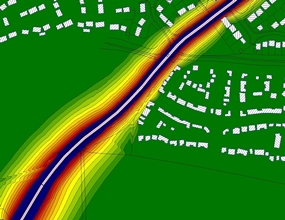
WBM utilises SoundPLAN noise mapping software for the modelling of Bloxham Road Noise Mappingindustrial and residential developments.

Using site plans and height data a three dimensional model of such developments can be created and the propagation of noise from numerous sources in the model can be calculated with reflections as well as ground and barrier attenuation taken into account.

SoundPLAN allows the use of a variety of calculation methods including ISO-9613, BS 5228, Calculation of Road Traffic Noise (CRTN) and the IOA Good Practice Guide for ETSU-97 for wind turbines among others.

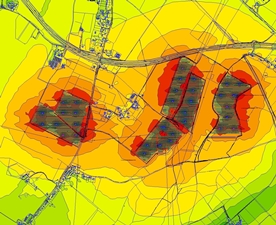
Nackington Noise MappingThe results of the calculations can be displayed as a noise contour map or can be presented as tables of data for individual receiver locations with a breakdown of the contribution of the various sources and the calculated attenuation between source and receiver.

WBM has used SoundPLAN for the modelling of mining/quarrying operations, testing of road traffic noise barriers, rail noise, input into the design/layout of residential developments, the impact of road alterations, wind turbines, solar farms, industrial plant sites and M&E plant on commercial buildings.

Examples of our work in this area include:

West Kettering Residential Development
Input into the design/layout and phasing of the residential development to minimise the noise impact of the nearby dual carriageway (read more…)

Bloxham Road, Banbury
Assessment of the noise impact of changes to the road layout and alteration of the speed limit due to a new residential development.

Alpha Lake Ecological and Landscape Enhancements
Assessment of the noise impact on nearby residences and wildlife in the adjacent nature reserve of proposed shallowing of the lake by means of imported material.

Manor Farm Tetsworth Road Traffic Noise Bunding
Examining the effectiveness of proposed bunding between the property and the M40.

Aggregate Industries Bardon Hill Quarry Extension
Model of the ongoing activities on site and in a substantial extension area to accompany a planning application.

Nackington Solar Park
Examination of the noise impact on nearby residences of a proposed solar farm.

Foxhills Residential Development, Brackley
Assessment of the road traffic noise impact on a proposed residential development.

Napleton Lodge Wind Turbine
Noise assessment to support a planning application for the construction of a wind turbine near Raunds.

Odeon Farnham
Modelling of the noise levels due to the operation of M&E plant on the roof of a cinema.

HS2 Tunnel relocation
Modelled the noise implications of the relocation of a proposed tunnel for HS2 for a group of local residents.

Main Menu